Introduction: Why AI Automation Is Transforming Modern Businesses
When organizations explore AI automation for businesses, they are entering a transformative era where efficiency, scalability, and innovation converge to redefine how companies operate. In today’s highly competitive digital economy, businesses are under constant pressure to reduce costs, increase productivity, and deliver personalized customer experiences. This is where artificial intelligence automation becomes a game-changing solution.
AI automation enables companies to streamline repetitive tasks, optimize workflows, and make data-driven decisions with unprecedented accuracy. Leading technology innovators such as OpenAI and IBM have developed powerful AI systems that empower businesses to automate processes across various departments, including marketing, customer service, operations, and finance.
The significance of business automation using AI lies in its ability to operate continuously without fatigue, reducing human error while improving overall efficiency. As a result, businesses can focus on strategic growth, innovation, and customer satisfaction. This shift is why AI automation is no longer optional—it is essential for companies aiming to stay competitive in the global market.
What Is AI Automation for Businesses?
At its core, AI automation for businesses refers to the use of artificial intelligence technologies to perform tasks that traditionally required human intervention. These tasks can range from simple data entry to complex decision-making processes.
AI automation combines machine learning, natural language processing, and robotic process automation (RPA) to create systems that can learn, adapt, and improve over time. This dynamic capability allows businesses to achieve higher levels of efficiency and accuracy.
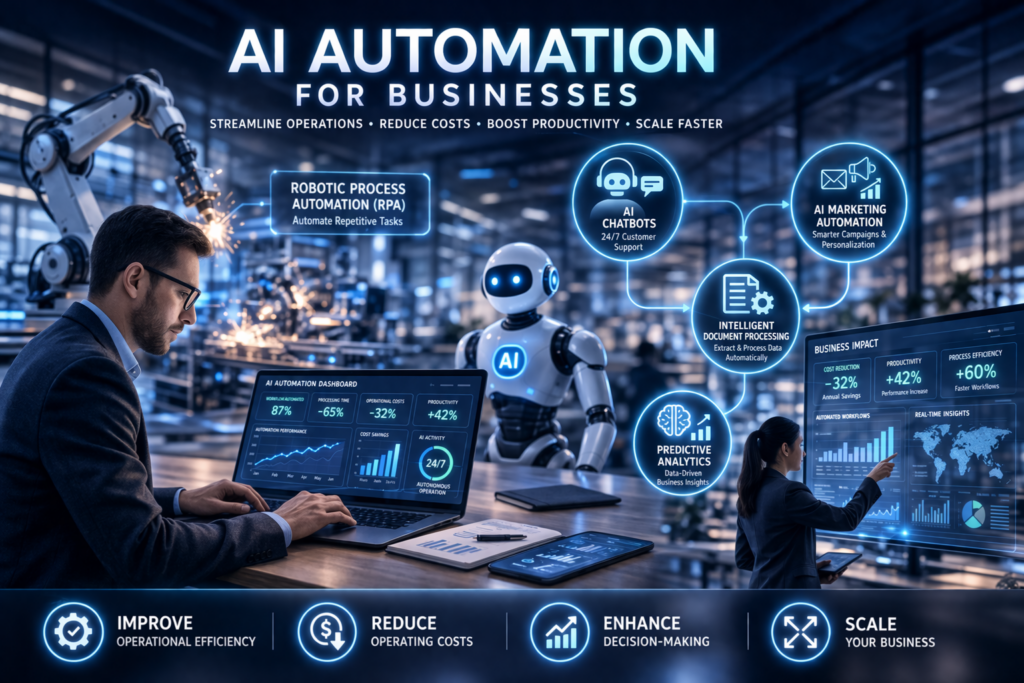
For example, AI-powered chatbots can handle customer inquiries 24/7, while predictive analytics tools can forecast market trends and customer behavior. These applications demonstrate how AI automation can transform various aspects of business operations.
Key Benefits of AI Automation for Businesses
Increased Efficiency and Productivity
One of the most significant advantages of AI automation is its ability to increase efficiency. By automating repetitive tasks, businesses can reduce workload and improve productivity.
Cost Reduction
AI automation reduces operational costs by minimizing the need for manual labor. This allows businesses to allocate resources more effectively.
Enhanced Decision-Making
AI systems analyze large volumes of data to provide actionable insights. This enables businesses to make informed decisions بسرعة and accurately.
Improved Customer Experience
AI-powered tools deliver personalized experiences, enhancing customer satisfaction and loyalty.
Top AI Automation Tools for Businesses


6
AI Chatbots for Customer Service
AI chatbots are one of the most widely used AI automation tools. Platforms like ChatGPT enable businesses to provide instant support to customers, improving response times and satisfaction.
Robotic Process Automation (RPA)
RPA tools automate repetitive tasks such as data entry and invoice processing. These tools are essential for improving efficiency in back-office operations.
AI Marketing Automation Platforms
AI marketing tools help businesses optimize campaigns, analyze customer behavior, and deliver personalized content. These tools significantly improve marketing ROI.
AI Data Analytics Tools
Data analytics tools powered by AI provide valuable insights into business performance, enabling companies to identify opportunities for growth.
Applications of AI Automation Across Industries
AI in Retail and E-Commerce
A-I automation enables personalized shopping experiences, inventory management, and customer support.
AI in Healthcare
Healthcare providers use AI to improve diagnostics, patient management, and treatment planning.
AI in Finance
Financial institutions leverage AI for fraud detection, risk assessment, and automated trading.
AI in Manufacturing
AI automation improves production efficiency, quality control, and predictive maintenance.
Comparison Table: AI Automation Solutions
| Solution | Use Case | Benefit | Industry |
|---|---|---|---|
| Chatbots | Customer service | Faster response | Retail |
| RPA | Data processing | Efficiency | Finance |
| Marketing AI | Campaign optimization | Higher ROI | Marketing |
| Analytics AI | Data insights | Better decisions | All |
How to Implement AI Automation in Your Business
Implementing AI automation for businesses requires a strategic approach. Start by identifying processes that can be automated and evaluating available tools.
Next, invest in training and development to ensure that employees can effectively use AI systems. Integration with existing workflows is also crucial for success.
Challenges of AI Automation
While AI automation offers numerous benefits, it also presents challenges such as data privacy concerns, implementation costs, and the need for continuous updates.
Future Trends in AI Automation
The future of AI automation is driven by advancements in technology. Innovations such as generative AI, edge computing, and autonomous systems will continue to shape the industry.
Conclusion: Driving Business Growth with AI Automation
The adoption of AI automation for businesses is transforming industries and creating new opportunities for growth. By leveraging AI technologies, companies can achieve greater efficiency, reduce costs, and enhance customer experiences.
As the digital landscape continues to evolve, businesses that embrace AI automation will be better positioned to succeed in an increasingly competitive market.
FAQs
1. What is AI automation in business?
It is the use of AI to automate tasks and processes.
2. Is AI automation expensive?
Costs vary depending on the tools and implementation.
3. Can small businesses use AI automation?
Yes, many tools are affordable and scalable.
4. What industries benefit most from AI automation?
Retail, healthcare, finance, and manufacturing.
5. How do I start with AI automation?
Identify processes and choose suitable tools.